
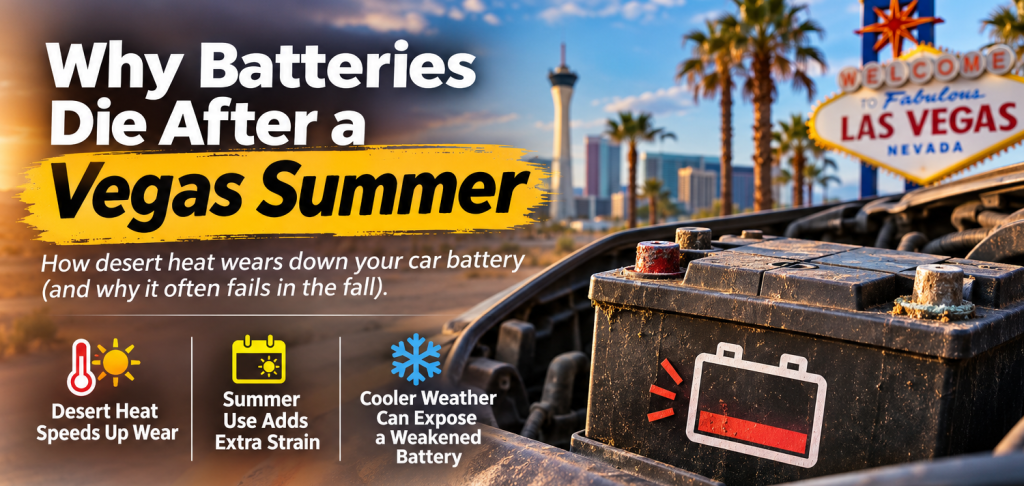
It happens every year in Las Vegas. The summer finally breaks, the mornings turn cooler and the car that survived 110 degree afternoons refuses to start. You assume the cooler weather did it, but that is rarely the whole story. Heat is the real culprit, and it does its damage slowly over many weeks. By the time fall arrives, many batteries have been worn down so far that even a mild change in conditions is enough to push them over the edge. This guide explains why so many car batteries fail after a Las Vegas summer, the warning signs to watch for, what you can do to protect your battery and when to have it tested or replaced. If you are searching for car battery replacement in Las Vegas, understanding what happened can help you make a smart choice.
How a Car Battery Works
A typical car battery stores energy through a chemical reaction between metal plates and an acid solution inside the case. When you start the car, the battery delivers a burst of power to the starter. Once the engine runs, the alternator takes over, powering the electrical system and recharging the battery. Over time, the plates wear, deposits form and the battery gradually loses its ability to hold a charge and deliver strong starting power. All batteries wear out eventually. What matters is how quickly, and temperature is one of the biggest factors.
What Desert Heat Does to a Battery
Heat speeds up the chemical reactions inside a battery. A little warmth can help a battery perform, but sustained high temperatures work against it. Here is what happens over a long, hot summer:
- Faster internal wear. Heat accelerates the corrosion of the internal plates, which permanently reduces capacity.
- Fluid loss. In batteries that are not fully sealed, heat can evaporate water from the electrolyte, leaving the plates exposed and damaged.
- Sulfation. Deposits can build up on the plates and make it harder for the battery to charge and discharge.
- Increased self discharge. A hot battery loses charge on its own faster, which is a problem for a car that sits unused.
- Stress on the case and seals. Prolonged heat can cause swelling, leaks and damage.
Under the hood, temperatures can climb well above the air temperature, especially in stop and go traffic or when a car sits parked in the sun. A battery in that environment is working hard around the clock, and the wear adds up. Our post on how desert heat shortens your car battery’s lifespan in Las Vegas goes into more detail on how this works.
Why the Failure Shows Up in the Fall
If heat does the damage, why does the battery so often die in fall or winter? There are a few reasons that work together.
Summer wears it down, cooler weather exposes it
A battery that has lost a chunk of its capacity can still start the car during summer, because a warm engine and warm oil are easier to turn over. When temperatures drop, engine oil gets thicker, and the starter needs more power to turn the engine. Chemical reactions inside the battery also slow down in cooler weather, so the battery delivers less power exactly when the engine needs more. A weakened battery that was barely coping in the heat may no longer be able to keep up.
Summer travel and heavy use
Road trips, long drives and heavy air conditioning use put extra demand on the charging system and the battery. After a summer of this, a battery that was already tired may be close to the end.
Short trips and idle time
Short drives in hot weather do not always give the battery enough time to recharge. A car that sits for days during vacations or hot spells can lose charge while parked. Over time, that pattern can leave a battery chronically undercharged, which speeds up wear.
The slow decline goes unnoticed
Battery decline is gradual. Starting may take a fraction of a second longer each week, and you may not notice until a cool morning makes the difference obvious. By then the battery may already be near the end of its life.
Warning Signs of a Weak Battery
Catching the problem early can save you from being stranded. Watch for these signs:
- Slow cranking. The engine turns over more slowly than it used to, sometimes with a drawn out sound.
- Clicking when you try to start. A rapid clicking noise often means there is not enough power to turn the starter.
- Dim headlights or interior lights, especially at startup or at idle.
- A battery or charging warning light on the dashboard.
- Electrical glitches, such as a radio that resets, power windows that move slowly or a screen that flickers.
- Swelling or bulging of the battery case.
- Corrosion on the terminals, which looks like white, blue or green crusty buildup.
- A rotten egg smell near the battery, which can mean it is leaking or overheating.
- An older battery. Batteries do not last forever, and one that has been in service for several years in the desert may be nearing the end.
If you see a swollen, cracked or leaking battery, do not try to jump start it. Car batteries contain acid and can release flammable gas, so have it checked by a professional.
Is It the Battery or Something Else?
Not every no start is the battery. A failing starter, a bad alternator, poor connections or a fuel or ignition problem can create similar symptoms. If a new battery dies again soon, or the battery light stays on while driving, the charging system may be at fault. A technician can test the battery, the starter and the alternator to tell what is really going on, so you replace only what you need to.
How to Protect Your Battery in the Desert
- Park in shade or a garage when possible. Cooler surroundings reduce the heat your battery has to endure.
- Keep the terminals clean and tight. Corrosion and loose connections make a weak battery work harder.
- Have the battery tested before summer and again before cooler weather. A quick test can show how much life is left.
- Take longer drives now and then, so the battery has time to recharge fully.
- Limit accessory use with the engine off. Leaving lights, chargers or the radio on drains the battery.
- Secure the battery. A battery that is not held down properly can be damaged by vibration.
- Follow your owner’s manual for the right battery type and any special requirements. Some vehicles, especially those with start stop systems or advanced electronics, need a specific kind of battery.
- Pay attention to early signs. Do not wait for a total failure.
For more ideas about keeping your car in shape during the hottest months, see our guide to summer car maintenance tips for Las Vegas.
What Battery Replacement Involves
Replacing a car battery sounds simple, but there are details that matter:
- Choosing the right battery. Size, terminal layout, power rating and type all need to match your vehicle. Your owner’s manual lists what is required.
- Testing the charging system. A new battery will not last if the alternator is not charging it properly, so a good technician will check.
- Cleaning the cable ends and terminals, so the new battery has a solid connection.
- Handling the electronics. Some vehicles need power maintained during the swap, or settings may need to be reset, and some newer vehicles may require the new battery to be registered with the vehicle’s computer.
- Disposing of the old battery responsibly. Old batteries contain hazardous materials and should be recycled properly.
A technician can handle these steps safely and make sure everything works before finishing the job.
Why a Mobile Mechanic Makes Sense for a Dead Battery
A dead battery is one of the best jobs for mobile service. You do not have to call a tow truck or wait in a hot parking lot, and you do not need to find a ride to a shop. A mobile mechanic can come to your home, your office or wherever the car is parked, test the battery and charging system and install a new battery on the spot in many cases. That convenience matters most in Las Vegas, where waiting in the heat is no fun. Some vehicles have batteries in hard to reach places or need specialized procedures, and a technician will tell you if a job needs a shop.
When to Replace Instead of Jump Starting
A jump start can get you moving, but it does not fix a worn out battery. Consider replacement if:
- The battery has needed more than one jump recently.
- A test shows it cannot hold a charge or deliver enough starting power.
- The case is swollen, cracked or leaking.
- The battery is old enough that failure is likely, based on your owner’s manual and a technician’s test.
- You depend on the vehicle and cannot risk being stranded.
Be Ready Before the Cold Mornings Arrive
The best time to deal with a weak battery is before it leaves you stranded. After a long, hot summer, a quick battery test is one of the smartest things you can do for your car. If the battery is fine, you get peace of mind. If it is not, you can replace it on your schedule rather than on the side of the road.
If your car has been slow to start, or you simply want to know how your battery held up after the summer, visit our homepage to learn more, or contact us to schedule a visit.